
How Lies Block Transformation
How Lies Block Transformation — and What Sets You Free
Lies block transformation. That is the plain, direct claim the apostle Paul makes in Colossians 3:1–11, and if you have ever spent years managing the distance between who you actually are and who everyone around you thinks you are, you already know it is true. The exhaustion of protecting that gap is its own kind of prison.
Most people who struggle with honesty are not career liars. They are people who got hurt, or embarrassed, or who learned early that being real cost too much — so they got good at small adjustments. "I'm fine." "It wasn't a big deal." "I've got it handled." The version of the story that makes you look a little better, or at least makes things a little easier in the moment. Nobody around you would point to you and say you have a problem with honesty. But in your heart, if you're being honest with God about that, you know there are places you are hiding.
Paul's point in Colossians 3 is not that honesty is a virtue to admire. It is that lies — including the small, self-protective kind — actively prevent God from doing the work in you that he wants to do. And the truth, even the hard kind, is the only thing that sets you free.
Most people who struggle with honesty are not career liars. They are people who got hurt, or embarrassed, or who learned early that being real cost too much — so they got good at small adjustments. "I'm fine." "It wasn't a big deal." "I've got it handled." The version of the story that makes you look a little better, or at least makes things a little easier in the moment. Nobody around you would point to you and say you have a problem with honesty. But in your heart, if you're being honest with God about that, you know there are places you are hiding.
Paul's point in Colossians 3 is not that honesty is a virtue to admire. It is that lies — including the small, self-protective kind — actively prevent God from doing the work in you that he wants to do. And the truth, even the hard kind, is the only thing that sets you free.
Why Does Lying Come So Naturally — Even to People Who Know Better?
Paul does not open with the command. He opens with the mind. In Colossians 3:1–4, he writes: "If then you have been raised with Christ, seek the things that are above, where Christ is seated at the right hand of God. Set your minds on things that are above, not on things that are on earth."
The instruction to seek heavenly things is not a call to be otherworldly or disconnected from real life. It is a call to stop measuring yourself by the standards of the people around you. Because when you do that — when you compare yourself to your neighbor, your coworker at the plant, the guy down the road who seems to get away with everything — you will always find someone who makes your choices look acceptable. Paul is saying that is not the measuring stick. Hold yourself up next to Jesus. When you do that honestly, it changes the kind of honesty you need.
We justify ourselves constantly. Someone tells a half-truth and says, "Well, people do worse." A person hides a struggle and says, "I'm not hurting anyone." The rationale feels reasonable until the person you are measuring yourself against is Jesus — his integrity, his compassion, his willingness to be known fully and love anyway. The bar stops feeling manageable, and the desire to hide stops feeling necessary, because the goal shifts from looking good to being made new.
The practical starting point here is simple and costs something: stop comparing. Not as a motivational exercise — as a daily, honest act of letting Christ be the standard. If you have never done that and want to, the [What We Believe page at mytrinity.tv/about-us/what-we-believe/] is a plain-language place to start.
[INTERNAL LINK: What Trinity believes about transformation and faith — mytrinity.tv/about-us/what-we-believe/]
The instruction to seek heavenly things is not a call to be otherworldly or disconnected from real life. It is a call to stop measuring yourself by the standards of the people around you. Because when you do that — when you compare yourself to your neighbor, your coworker at the plant, the guy down the road who seems to get away with everything — you will always find someone who makes your choices look acceptable. Paul is saying that is not the measuring stick. Hold yourself up next to Jesus. When you do that honestly, it changes the kind of honesty you need.
We justify ourselves constantly. Someone tells a half-truth and says, "Well, people do worse." A person hides a struggle and says, "I'm not hurting anyone." The rationale feels reasonable until the person you are measuring yourself against is Jesus — his integrity, his compassion, his willingness to be known fully and love anyway. The bar stops feeling manageable, and the desire to hide stops feeling necessary, because the goal shifts from looking good to being made new.
The practical starting point here is simple and costs something: stop comparing. Not as a motivational exercise — as a daily, honest act of letting Christ be the standard. If you have never done that and want to, the [What We Believe page at mytrinity.tv/about-us/what-we-believe/] is a plain-language place to start.
[INTERNAL LINK: What Trinity believes about transformation and faith — mytrinity.tv/about-us/what-we-believe/]
What Happens When You Keep Hiding — Even the Small Things?
Paul moves from the mind to behavior in Colossians 3:5–8, listing the things that belong to the old life: "anger, wrath, malice, slander, and obscene talk." These are not abstract vices. They are the specific things that surface when a person is protecting themselves — when the gap between the real story and the public story gets wide enough that anger starts leaking out around the edges.
You can be the most put-together person in the room and still be carrying something that is slowly hollowing you out. The grief you never talked about. The marriage that is quieter than it used to be. The thing you did years ago that you have convinced yourself does not count anymore. The way you explained away the drinking, or the distance, or the days when getting out of bed felt like climbing out of a hole. Paul says all of that hiding — the big lies and the small ones, the outright falsehoods and the careful omissions — is killing something in you. And it is killing something in your relationships.
Ephesians 4:31–32 is the other side of this: "Get rid of all bitterness, rage and anger, brawling and slander, along with every form of malice. Be kind and compassionate to one another, forgiving each other, just as in Christ God forgave you." The only way to get there is through confession — not as a performance, but as the act of saying out loud what is actually true. One step toward this: name one thing you have been carrying alone, even if only to God first. You are not telling him anything he does not already know. And if you are in a season where that kind of conversation feels impossible to have with anyone, support groups and pastoral counseling at Trinity are available for exactly this — not to judge what you bring, but to help you carry it. [mytrinity.tv/resources/counseling/]
[INTERNAL LINK: Pastoral counseling and support resources — mytrinity.tv/resources/counseling/]
You can be the most put-together person in the room and still be carrying something that is slowly hollowing you out. The grief you never talked about. The marriage that is quieter than it used to be. The thing you did years ago that you have convinced yourself does not count anymore. The way you explained away the drinking, or the distance, or the days when getting out of bed felt like climbing out of a hole. Paul says all of that hiding — the big lies and the small ones, the outright falsehoods and the careful omissions — is killing something in you. And it is killing something in your relationships.
Ephesians 4:31–32 is the other side of this: "Get rid of all bitterness, rage and anger, brawling and slander, along with every form of malice. Be kind and compassionate to one another, forgiving each other, just as in Christ God forgave you." The only way to get there is through confession — not as a performance, but as the act of saying out loud what is actually true. One step toward this: name one thing you have been carrying alone, even if only to God first. You are not telling him anything he does not already know. And if you are in a season where that kind of conversation feels impossible to have with anyone, support groups and pastoral counseling at Trinity are available for exactly this — not to judge what you bring, but to help you carry it. [mytrinity.tv/resources/counseling/]
[INTERNAL LINK: Pastoral counseling and support resources — mytrinity.tv/resources/counseling/]
Why "I'm Fine" Is the Most Expensive Lie You Can Tell
Paul's instruction in Colossians 3:9–11 is direct: "Do not lie to one another, seeing that you have put off the old self with its practices, and have put on the new self, which is being renewed in knowledge after the image of its creator." The old self hides. The new self does not need to. The old self manages the gap between who you are and who people think you are. The new self lives in the freedom of being known and loved anyway.
There are four specific things followers of Jesus commonly lie to one another about. The extent of past sin — the chapters they would cut if they were editing their own story. The current state of temptation — the struggle they are in right now that no one around them knows about. Doubts and fears about God — the passages that don't make sense, the prayers that felt like they went nowhere, the season when faith felt like performance and nothing more. And the plain truth of what scripture actually says — the verses that, if taken seriously, would require a change they have not made yet.
Every one of those silences is a place where transformation stops. And every one of them is a place where honesty — the kind that costs something — makes room for something to shift. The lie that feels safest is almost always "I'm fine." And that one sentence, said to enough people over enough years, can build a life that looks functional and feels like a locked room.
There are four specific things followers of Jesus commonly lie to one another about. The extent of past sin — the chapters they would cut if they were editing their own story. The current state of temptation — the struggle they are in right now that no one around them knows about. Doubts and fears about God — the passages that don't make sense, the prayers that felt like they went nowhere, the season when faith felt like performance and nothing more. And the plain truth of what scripture actually says — the verses that, if taken seriously, would require a change they have not made yet.
Every one of those silences is a place where transformation stops. And every one of them is a place where honesty — the kind that costs something — makes room for something to shift. The lie that feels safest is almost always "I'm fine." And that one sentence, said to enough people over enough years, can build a life that looks functional and feels like a locked room.
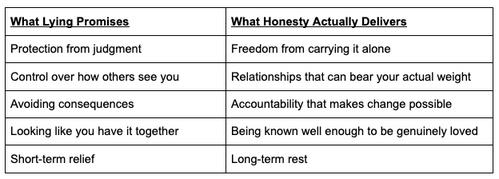
What the Honest Life Actually Costs vs. What It Gives Back
Iroquois County carries its weight quietly. That is part of what it means to grow up here, or come back here, or decide this is where you plant yourself and raise a family. People work hard, show up, and keep the hard things to themselves. There is dignity in that, and there is also a particular kind of loneliness — the kind where everyone around you knows your name but no one really knows what year you are actually having. Trinity Church in Watseka exists for people in that specific place. Not to fix you, and not to perform something at you on a Sunday morning, but to be a room where the real version of you can walk in and find people who are also being real. If you have been carrying something for a long time and you are tired of carrying it alone, the door is open. There is no script required.
The Only Thing That Actually Sets You Free
Lies block transformation. That is where this started, and it is where it lands. Not as a rule to follow, but as a description of what happens in a human life when the gap between the real story and the managed story gets wide enough: growth stops, relationships thin out, and the thing you were protecting yourself from quietly becomes the thing you are most afraid to lose.
The truth Paul keeps returning to in Colossians 3 is that the new self — the one being renewed after the image of its creator — does not need to hide. It is not because confession is easy or because people always receive it the way you hope. It is because the one who already knows the whole truth is already waiting with open arms, and the transformation you have been waiting for is on the other side of honesty, not before it.
If something in this landed and you want to take a next step — or if you just want to know more about who Trinity is and what it would feel like to walk in — we would be glad to have you. Plan your visit at the Watseka Campus and see what a Sunday morning looks like. Or if you're not ready for that, a Connection Card is a low-pressure way to tell us you're out there — ask for prayer, ask a question, or just let us know you read this. Either way, no performance required.
The truth Paul keeps returning to in Colossians 3 is that the new self — the one being renewed after the image of its creator — does not need to hide. It is not because confession is easy or because people always receive it the way you hope. It is because the one who already knows the whole truth is already waiting with open arms, and the transformation you have been waiting for is on the other side of honesty, not before it.
If something in this landed and you want to take a next step — or if you just want to know more about who Trinity is and what it would feel like to walk in — we would be glad to have you. Plan your visit at the Watseka Campus and see what a Sunday morning looks like. Or if you're not ready for that, a Connection Card is a low-pressure way to tell us you're out there — ask for prayer, ask a question, or just let us know you read this. Either way, no performance required.
FAQ's
How do lies block spiritual transformation?
According to Colossians 3:9–11, dishonesty keeps a person stuck in the "old self" — the patterns of self-protection that prevent God's renewing work from taking hold. When we hide sin, minimize struggles, or manage how others see us, we cut off the accountability and confession that make real change possible. Transformation requires honesty because you cannot heal what you refuse to name.
What does the Bible say about lying to one another?
In Colossians 3:9, the apostle Paul instructs believers to stop lying to one another because it belongs to the old, pre-Christ way of living. He grounds the command in identity: those who follow Jesus have "put off the old self" and are being renewed into the image of their creator. In John 8:44, Jesus describes Satan as "the father of lies" — making dishonesty not just a character flaw, but a spiritual alignment with the wrong side.
Why do I keep telling white lies to protect myself from judgment?
Small lies almost always start as self-protection — a way to avoid embarrassment, consequences, or rejection. The problem is that they work in the short term and compound over time, building a version of yourself that others relate to instead of you. Scripture's answer is not willpower but a change of reference point: when Jesus becomes the standard instead of the opinions of people around you, the fear of judgment loses its grip because you are no longer building a case for your own acceptability.
How do I rebuild trust in relationships after lying?
Rebuilding trust after a pattern of dishonesty takes time, and the people around you may initially receive the truth with skepticism — their defenses are reasonable. The most important thing is to begin telling the truth consistently, not to force a rapid restoration. In Colossians 3:12–14, Paul points toward clothed-in-compassion, patient, forgiving community as the environment where trust is rebuilt — not through one dramatic confession but through the accumulated weight of being honest over time.
How can I be more honest about my past sin and current struggles?
Start with God — not because it is easy, but because he already knows and the conversation costs nothing in terms of surprise. Then build what Paul calls a circle of trust: one or two people who have permission to ask the hard question, who know you well enough to receive what you bring. Confession to trusted believers is not about public exposure; it is about breaking the isolation that hidden sin creates. Professional pastoral counseling is also available for struggles that need more than a conversation.
We'd love to meet you in person or online.
Recent
Archive
Categories
no categories
No Comments